
Last Updated on June 19, 2026 by Statnzee Team
The Big Idea
While studying Probability Theory, you may encounter the famous Gambler’s Ruin Problem.
Imagine two gamblers repeatedly betting against each other. Each round:
- Gambler A wins with probability p
- Gambler A loses with probability q

The game continues until one gambler loses all their money.
A natural question is:
What is the probability that Gambler A eventually wins?
To answer this, we define a sequence of probabilities and derive a recurrence relation.
Step 1: Define the Probability
Let

represent the probability that a gambler eventually wins if they currently have 
After the next bet:
- With probability
, they move to state
- With probability
, they move to state


Therefore,

This is a second-order linear recurrence relation.
Step 2: Guess a Solution
A common technique for solving recurrence relations is to assume a solution of the form

Substituting into the recurrence gives

Divide both sides by 

Rearranging:

We now have a quadratic equation.
Step 3: Apply the Quadratic Formula
Using
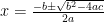
with

gives

Step 4: Simplify the Discriminant
Since

we have

which simplifies to

Therefore,

Substituting:

Step 5: Find the Two Roots
First Root

Since

we get

Second Root

Using

gives

Therefore the two roots are

Why Are There Two Solutions?
We have found two sequences that satisfy the recurrence relation:
Solution 1

Solution 2

Both satisfy

Why Can We Add Them Together?
The recurrence relation is linear.
Suppose

and

are solutions.
Then

and

Multiplying by constants 


Therefore,

is also a solution.
This property is called the Principle of Superposition.
The General Solution
Since the recurrence has two independent solutions,

and

the most general solution is

which simplifies to

The constants 


and

What Area of Mathematics Is This?
This topic belongs primarily to Probability Theory and Stochastic Processes.
However, the solution uses tools from several mathematical disciplines:
Probability Theory
- Gambler’s Ruin
- Random Walks
- Markov Chains
Algebra
- Quadratic equations
- Factoring and simplification
Difference Equations
- Recurrence relations
- Discrete mathematics
Linear Algebra Concepts
- Linear combinations
- Independent solutions
Difference Equations vs Differential Equations
Many students notice similarities with calculus.
A differential equation works with derivatives:

A difference equation works with shifted terms:

| Differential Equations | Difference Equations |
|---|---|
| Continuous variables | Discrete variables |
| Derivatives | Shifts |
| Calculus | Discrete Mathematics |
In fact, recurrence relations are often called the discrete analogue of differential equations.
Key Takeaway
The Gambler’s Ruin problem is fundamentally a probability problem, but solving it requires a powerful technique from discrete mathematics:
- Build a recurrence relation.
- Guess a solution of the form
.
- Solve the characteristic equation.
- Find the roots.
- Combine independent solutions.
- Apply boundary conditions.
The final form
is the general solution from which the gambler’s probability of eventual success can be determined.
Discover more from Statnzee
Subscribe to get the latest posts sent to your email.
Leave a Reply